A person can spend years, and make a career out of designing and building Data Models. There are generic data models, industry-specific ones, and then there are functional data models. Each with its own sets of signs and symbols, sometimes its own language, and certainly, its own learning curve.
Here is an example from IBM, ServiceNow, and Teradata. SaaS companies publish their data model blueprints so that enterprises can map their internal systems to a “standard”, which makes migration/integration easy. Industry-focused institutions (such as TM Forum) publish their version to focus on industry-specific nuances and use a bunch of jargon. And finally, there are ontologies.
The simplest way to understand data model vs. ontologies is to think specific vs. generic. Data models are often application-specific (industry or software applications; hence TM Forum and SaaS providers publish their data models). IMO, Ontologies are meant to help understand what exists and how it is related, without drilling into every specific detail (although many have gone that route too). They allow for a scalable understanding of a concept, without explaining the concept in detail.
Here, I attempt to represent the simplest data model one can draw for an enterprise. It probably applies to 80% of situations and to B2B, B2C, B2B2C, or D2C business models.
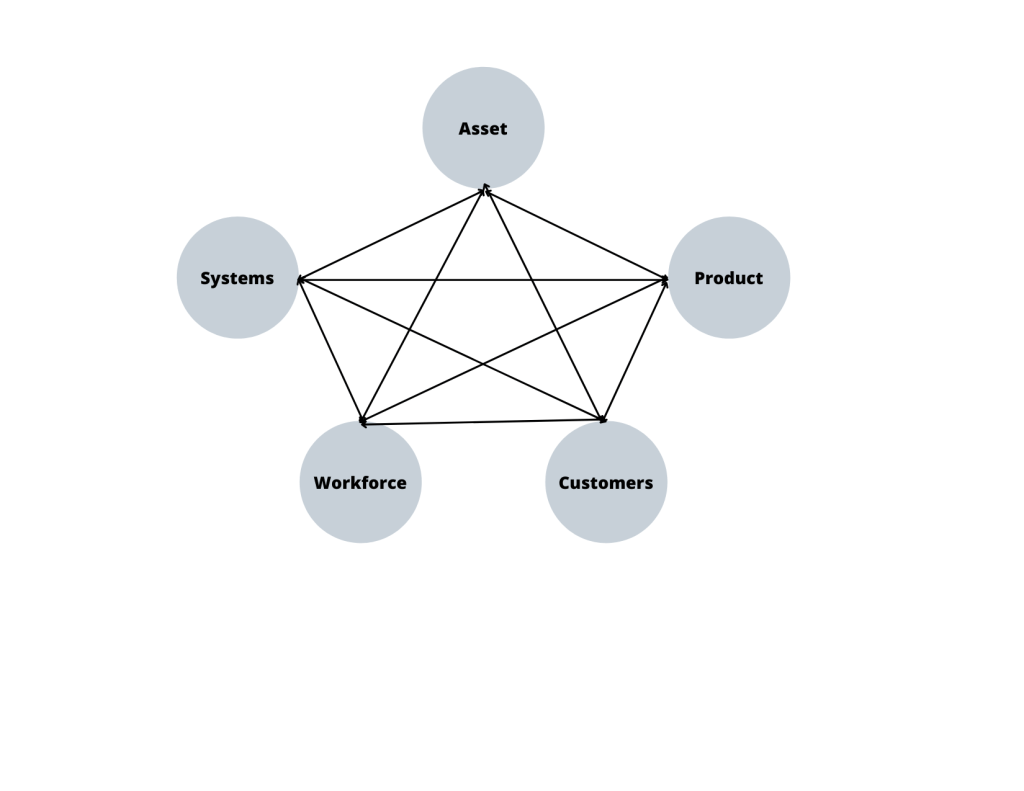
I think that any enterprise process can be represented as a combination of one of the more basic entities (asset, product, customer, workforce, and systems). Take customer service for example. A customer tries to pay their bill online (customer -> systems). The transaction fails. The customer then calls into a contact center, talks to an employee, complains about the issue, and eventually resolves the issue. (customer -> workforce -> system).
How would this picture work for a multi-sided platform company (because everyone is a platform company, just like everyone was a technology company). In a multi-sided platform, your producers/suppliers are your consumers too. Unless you treat them like customers, serve them as customers, and retain them as customers, you won’t have a thing to sell on your platform.
Now the trick is to expand this picture as needed. But let us save that for another post.
 The Psychology of Intelligence
Leave a comment