Okay, so I’ve been kicking around the whole AI thing for a while now, chatting with colleagues, clients, and partners from all corners of businesses – marketing gurus, the engineering brain trust, the suits upstairs, and the data wizards. Honestly, it’s been a bit of a whirlwind. Some people are chasing those immediate, shiny AI toys, while others are gazing way off into the future, dreaming up completely different business models.
One thing’s for sure: there’s no magic AI button that works for everyone. But after all these conversations, a sort of pattern started to emerge in my head, a way to roughly categorize how AI is actually being used out there in the real world. Not the sci-fi stuff, or the deep technical nitty-gritty, but what companies are actually doing with it right now.
Now, this isn’t some definitive truth, mind you. It’s just a way I’ve found to wrap my head around things, and it feels a little closer to reality than some of the more rigid frameworks I’ve seen floating around. I’m really focusing on the applied side of things – what’s getting built and put to work, not the theoretical research or the intricate details of how those models are trained.
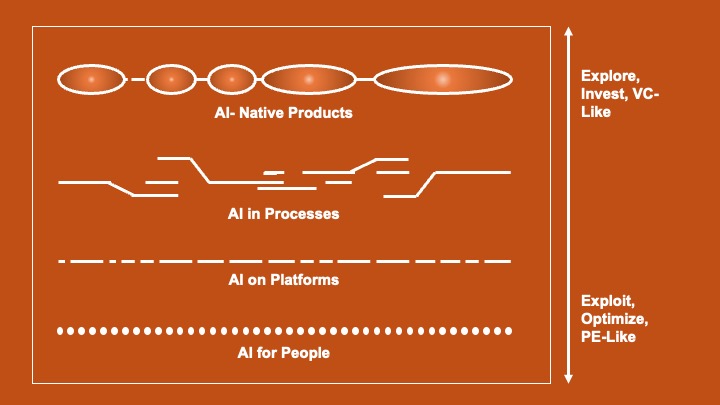
So, here’s how I’m currently thinking about it – four layers, starting with what seems like the easiest stuff and maybe moving towards the more potentially groundbreaking (though who really knows for sure, right?):
1. AI for People:
This feels like the most accessible entry point. Think about those tools that slot right into how we already work. Copilot helping you not sound like a total mess in emails or summarizing those endless meeting transcripts, or ChatGPT / Claude / Gemini (most of the times) actually answering your questions. The cool thing here is you don’t have to rip up your existing systems or change your whole workflow. You’re just giving your team some potentially smarter tools. Seems like a relatively low-stakes way to dip your toes in and maybe see some quicker wins.
2. AI on Platforms:
This is where AI starts to get baked into the software we’re already using day-to-day. Think about your CRM like Salesforce or HubSpot suddenly being a bit more insightful – maybe it’s prioritizing leads in a smarter way, suggesting your next best action, or spotting trends in your data you might have missed. A lot of this isn’t stuff you’re building from scratch; it’s coming from the vendors of these platforms. Still, it can quietly have a pretty significant impact on how things get done.
3. AI in Processes:
Now we’re starting to get into territory where companies are looking at their core operations and thinking about how AI could fit in. Automating some of those repetitive steps, making decisions a little faster, maybe even improving accuracy in certain areas. This usually means rolling up your sleeves a bit more – probably some custom development, definitely needing to tap into your own company data, and really thinking through how these changes will affect people and processes. The potential upside feels bigger here, but so does the effort involved.
4. AI-Native Products:
This feels like the wild frontier, the stuff that maybe wouldn’t even exist without AI at its core. Think about products that can generate content from scratch, make predictions that feel almost uncanny, or learn and adapt based on how people actually use them. These aren’t just souped-up versions of old products; they’re potentially completely new kinds of experiences. Definitely feels riskier to build and launch, but maybe these are the ones that could really shake things up in the long run.
As you sort of mentally climb these layers, it feels like you’re generally shifting from:
- Looking for those quick, noticeable improvements to thinking about longer-term, more strategic plays.
- Grabbing off-the-shelf solutions to needing to build more tailored, custom approaches.
- Trying to make the existing stuff a little better to venturing into creating entirely new things.
- Relying on what we’re pretty sure works to exploring what might work, with a bit more uncertainty involved.
It’s interesting to note that most companies probably won’t march through these layers in some neat, orderly fashion, and honestly, that’s probably okay. Maybe the real value isn’t about ticking off all the boxes, but more about having a sense of where you are right now and where you might want to focus your energy next.
If you’re in the thick of trying to figure out what AI means for your company, maybe this rough breakdown can be a helpful way to cut through some of the hype and make a little more sense of it all. At least, that’s what I’m hoping.
 The Psychology of Intelligence
Leave a comment